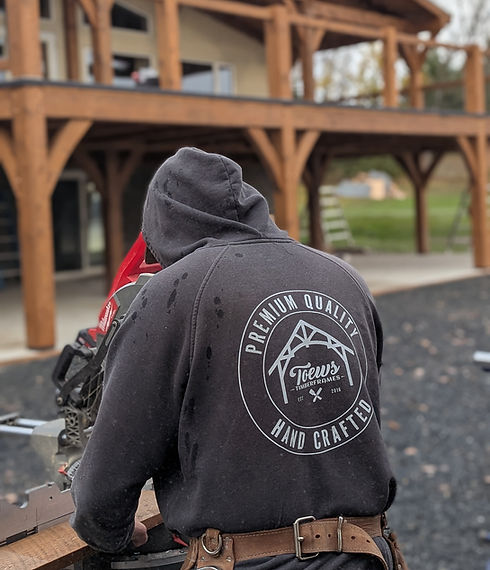
Timber Joinery
Every Cut Tells a Story.
Timber framing is one of humanity's oldest building traditions, with roots stretching back more than 7,000 years. At its heart lies a simple, profound truth: wood joined to wood, shaped by human hands, creates structures of extraordinary strength and beauty that endure for centuries.
We practice this craft the way it was always meant to be practiced, by hand. Our craftsmen read each timber individually, understanding its grain, its character, and its natural tendencies, before a single mark is made. This intimate knowledge of the material is something no computer program or CNC machine can replicate.

Mortise & Tenon
The workhorse of timber framing and the oldest recorded woodworking joint in human history — dating back over 7,000 years. A projecting tenon on one timber fits precisely into a corresponding mortise (pocket) cut into the receiving timber. The joint is then locked permanently with a hand-turned hardwood peg driven through both members.
In a handcrafted frame, the tenon is sized and shouldered to account for the specific timber's dimensions and the loads it will carry. Variations include the shouldered mortise & tenon, the diminished housing, and the through tenon.

Dovetail
The dovetail is one of the most beautiful and mechanically ingenious joints ever devised. Its characteristic flared, fan-shaped geometry creates a self-locking connection that becomes stronger under tension — the harder you pull, the tighter it holds.
In timber framing, the dovetail connects floor joists to carrying beams (girts) and roof purlins to rafters. A hardwood wedge is often driven alongside the joint to draw it tight and keep it snug as the timber seasons.

Post/Beam & Knee Brace
The knee brace is the diagonal member that triangulates the connection between a post and a beam, providing lateral stability to the entire frame. Without knee braces, a timber frame would be susceptible to racking forces from wind and seismic loads.
Each end of a knee brace is joined with a mortise and tenon connection, typically one to two inches wide and four inches deep, cut at a precise compound angle. In a handcrafted frame, the craftsman lays out these compound angles directly on the timber using traditional scribing tools — a skill that takes years to master.

Scarf Joint
A scarf joint — also called a splice joint — joins two timbers end-to-end to create a single member longer than any available timber. Interlocking notches are cut into both ends, the pieces are fitted together, and a peg through the center locks them in place.
The most sophisticated scarf joints, such as the bladed scarf and the tabled scarf with keys, are masterworks of three-dimensional geometry that resist tension, compression, and bending simultaneously. These joints are a testament to what a skilled hand-cutter can achieve with nothing more than a chisel and a mallet.
THE METHODS
Traditional Layout &
Cutting Techniques
The way a joint is laid out and cut is just as important as the joint itself. Two ancient systems — Scribing and Square Rule — define the two great traditions of handcrafted timber framing, and our craftsmen are fluent in both.

Scribing: The European Tradition
Scribing is the oldest and most intimate of the two layout methods, brought to North America by European settlers who had refined it over centuries. In scribing, one timber is held physically against another, and a marking tool traces the exact profile of the mating surface directly onto the timber to be cut. Every joint is unique to its specific pair of timbers.
Because scribed timbers cannot be interchanged, each piece is numbered and must be assembled in exactly the right position. The reward is joinery of extraordinary tightness — joints that fit the actual timber, not an idealized version of it. Scribing excels when working with hand-hewn, irregular, or naturally curved timbers where no two surfaces are alike.

Square Rule: The American Tradition
Developed by North American timber framers in the 18th century, the square rule system was a revolutionary insight: within every irregular hand-hewn timber lies a smaller, perfectly square and straight timber. By aligning all joinery to this imaginary perfect inner timber, multiple pieces can be cut to the same specifications and assembled interchangeably.
Square rule made it possible to build larger structures faster, and it became the dominant system for the great barn-raising tradition of rural America. In a handcrafted square rule frame, the craftsman uses a combination square, a marking gauge, and a mortise chisel to lay out and cut each joint with precision — no CNC machine required, just skill, patience, and an intimate understanding of wood.

Draw-Boring: The Living Lock
Draw-boring is the ancient technique of deliberately offsetting the peg holes in a mortise and tenon joint so that driving the peg draws the joint tight with mechanical force. The hole through the tenon is bored slightly off-center relative to the hole through the mortise — typically by 1/16 to 3/16 of an inch.
When the tapered hardwood peg is driven through, it must deflect to pass through both holes, and in doing so it pulls the tenon shoulder hard against the mortise face. The result is a joint under constant, self-generated compression — no clamps, no glue, no metal. As the peg swells with moisture over time, the connection only grows tighter. It is one of the most elegant engineering solutions in all of woodworking.
The Case for Handcrafted Joinery
In an age of automation, choosing a handcrafted timber frame is a deliberate act, an investment in quality, longevity, and the irreplaceable value of human skill applied to natural material.
Structural Integrity That Improves With Age
Handcrafted joints are designed with wood movement in mind. As timbers season and shrink, draw-bored pegs and wedged connections actually tighten, creating a frame that grows stronger over decades. Machine-cut joints, cut to theoretical dimensions, can open up as the timber moves away from its reference point.
Unlimited Design Freedom
A handcrafted frame has no size limits, no geometry constraints, and no machine envelope to work within. Curved timbers, oversized beams, complex compound angles, custom decorative profiles — if it can be drawn, our craftsmen can cut it. This freedom is simply not available with machine-cut production framing.
Centuries of Proven Performance
The oldest surviving timber frame structures in the world — medieval halls, Japanese temples, colonial barns — were all built by hand. Many are still standing after 500 to 1,000 years. The handcrafted timber frame is not a nostalgic experiment; it is the most thoroughly proven building system in human history.
A Sustainable Legacy
Timber framing uses wood at its most efficient — large structural members that require minimal processing, joined without metal or adhesives, and designed to last for generations. A well-built handcrafted timber frame is one of the most sustainable structures you can build, locking carbon in place for centuries.
Visible Beauty in Every Joint
In a timber frame home, the structure is the architecture. Every joint is on display, and the quality of the craftsmanship is visible to anyone who looks. Handcrafted joinery has a warmth, precision, and character that no machine can produce — the slight tool marks, the perfect shoulder lines, the grain-matched pegs.
The Human Investment
When you commission a handcrafted timber frame, you are not purchasing a product — you are engaging a craftsman. Our team invests weeks or months of skilled labour into your frame, learning its timbers, solving its challenges, and taking personal pride in every joint. That investment becomes part of your home forever.